What Event in Nazi Germany Targeted Jewish Families, Destroying Businesses and Synagogues?
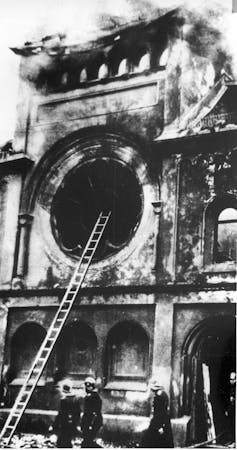
Many people are familiar with the archival photographs depicting the brutality that swept beyond Federal republic of germany and its annexed territories during the nights of Nov. 9 and 10, 1938. They draw the aftermath of the subversive forces that descended upon Jewish businesses, homes and places of worship by the men of the SA (Sturmabteilung) and the Hitler Youth.
Their unbridled hatred is illustrated past mounds of shattered glass that littered sidewalks and streets of German cities and towns, inspiring the name "Kristallnacht" or Nighttime of Broken Glass. Such photographs provide important visual evidence of the attacks and the concrete damage that occurred.
The men who carried out the attacks, and those on the receiving end of the Nazi violence, may exist less familiar to us. Grappling with the human dimension of the Kristallnacht pogrom removes information technology from the realm of a long-passed historical consequence and transforms information technology into an activity of contemporary relevance.
Hypermilitarized masculinity
Confronting such events illuminates how human behaviour ever carries far-reaching consequences.
As a scholar who has studied post-Holocaust conceptualizations of masculinity and explored the Jewish family in pre-Holocaust Germany, I think about how gendered responses and behaviours instruct and integrate individuals into a wider guild.
During the Kristallnacht pogrom, fascist masculinity — roughshod, hypermilitarized and unrestrained — caused physical destruction of Jewish-owned business, homes and 276 synagogues. All the same information technology also operated in opposition to the German, bourgeois model of masculinity and it attacked the very foundation of Jewish life: the family.
The attack on Jewish public, religious and private spaces, followed by rounding up and arresting Jewish men, left Jewish families were even more vulnerable than they already were and forebode the devastation that followed. This came firstly as an unprecedented assail on Jewish masculinity and a witting effort to destabilize the familial and societal roles of Jewish men.
'Tough as leather'
Information technology should not come equally a surprise that the Hitler Youth were active protagonists in the Kristallnacht pogrom. Although the Hitler Youth movement was primarily aimed at boys betwixt the ages of 14 and eighteen, they were envisioned as the generation that would inherit the accomplishments of the Nazi Reich and equally such were emboldened to demonstrate their concrete prowess.
When Hitler spoke to youth at the Nazi Political party rally in 1935, he challenged them to become "as swift equally a greyhound, equally tough as leather and every bit difficult as Krupp'south steel."
The analogy is laden with military implications that reminds us that leather is resilient to vesture and tear, yet supple enough to be molded to the wearer's physique. Krupp's steel invokes an ideological overtone that is analogous with expiry and destruction: Krupp produced armaments for the German language army during the Kickoff Globe War. Boys in the Hitler Youth movement were encouraged to go the tough, resilient soldiers who were prototypes of High german fascist masculinity.
Past contrast the SA, or Brownshirts equally they were commonly called, was a paramilitary movement that frequently engaged in street fights and brawls. They were essential to the early rise of Hitler and his fascist party and adult into an organization of over one million members. The SA promoted a masculinity that was at times unpredictable and promised young High german men its ain egalitarian and homosocial community.
Seeped in anti-Semitism
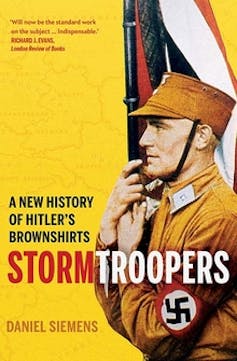
This camaraderie extended only to non-Jewish German men and was seeped in anti-Semitism and violence. Historian Daniel Siemens has written that the SAs tendency of violence acted as a valve for the Brownshirts' pent-upwardly assailment and was a consequence of their ideological convictions. If violence served as a valve, then the Kristallnacht pogrom provided them with an nigh unfettered opportunity to reign terror upon the fascists' favourite scapegoats, the Jews.
While the street fights and physical defacement was primarily the purview of the Hitler Youth and the SA, units of the SS (Schutzstaffel) and the Gestapo co-ordinated the arrests of some xxx,000 Jewish men. Every bit the pogrom that we at present call Kristallnacht spread, the men were deported to Dachau, Buchenwald, Sachsenhausen and other concentration camps in the German Reich.
Photographs depicting these arrests are haunting in the lodge and precision with which they were carried out. The arrested Jewish men expect orderly and sombre, dressed in business attire — as befitted their roles as bourgeois, German citizens.
Men first to be taken
As loyal citizens of Federal republic of germany, many of whom had familial roots extending dorsum generations or had fought in the Beginning World War for Germany, these men could not have imagined what awaited them in the Nazi concentration camps. Nor could they empathize why, as law-biding loyal citizens, they were targeted.
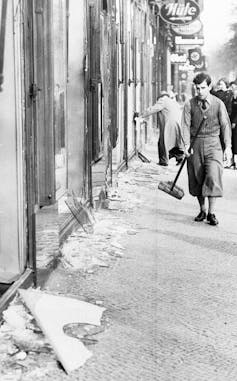
Regardless of whether the attackers were Hitler Youth, SA or SS, when Nazi perpetrators attacked Jewish-owned business, or trounce and humiliated Jews in the streets, they sent a clear message that traditional societal norms no longer prevailed.
Until this fourth dimension, Jewish men and women in Western and Key Europe had adapted themselves to the prevailing model of bourgeois family life. This model conferred responsibility for the financial and physical survival of the family upon men as heads of households, only placed its psychological and spiritual well-being in the hands of the women.
The events of Kristallnacht demonstrated that Jewish men could no longer protect their families, nor guarantee their safety during the National Socialist regime. Jewish men, women and children were thrust into situations that they were sick-prepared to meet and were increasingly difficult to navigate.
In the days and months that followed Kristallnacht, Jewish women, wives, sisters and daughters were thrust into new roles every bit providers and defenders of the family. They sought ways to secure the release of men arrested and to rise across the expectations of their bourgeois gender roles.
Although fascist masculinity may take been an barb to some of the German suburbia and the elite, information technology nevertheless dominated civil gild, foreshadowing in 1938 that the worst was notwithstanding to come up.
[ Deep knowledge, daily. Sign up for The Conversation'due south newsletter. ]
Source: https://theconversation.com/kristallnacht-of-1938-shattered-glass-and-unleashed-a-brutal-fascist-masculinity-126572

Post a Comment for "What Event in Nazi Germany Targeted Jewish Families, Destroying Businesses and Synagogues?"