How to Come Up With Martial Arts Moves Names
Taekwondo techniques vary betwixt most schools and level and not all techniques are included. Techniques oftentimes combined into shorter prepare (Hyeong), only these vary from schoolhouse to school.
Hand attacks [edit]
Taekwondo hand strikes are performed as a close distance culling to kicks. They are executed in a number of ways from standing, jumping, spinning and rushing forwards. Hand strikes make upward fast combinations of strikes which can get out an opponent stunned and unable to defend himself. Taekwondo hand strikes tin exist separated into two distinct styles:
- Closed hand strikes ( jireugi )
- Open manus techniques ( chigi )
Diverse surfaces of the hand may exist engaged equally the striking surface depending on which area of the opponents body which is existence targeted. This leads to a large assortment of hand positions.
- Forefist - A closed fist may exist jabbed out directly to strike with the forefist knuckles. This is a suitable position for general punches to soft areas of the body. Without protection, it is inadvisable to strike the bony face up as fingers are likely to go broken on the difficult temple and jaw basic.
- Hammer fist - A closed fist may be brought down in a hammering motion to strike with the underneath. Such a strike can obliterate an opponent'southward nose, making it nearly impossible for him to retaliate.
- Backfist - A Son Deung clenched manus is swung backwards into the face of an opponent. The back of the hand makes contact and the momentum garnered in the swing makes this a powerful strike. Spinning backfists are a knockout dial and banned in most Taekwondo competitions.
- Knifehand - 'Sonkal' is the Taekwondo name for a motility similar to the "karate chop", i.e. where an open up paw is hammered down to make impact with the underside. A ridgehand is the opposite, where the top of the open hand strikes. These are commonly made to the side of the neck.
- Fingertips - Jumeok can be used to strike vulnerable areas of the body such as pressure level points. Iv finger strikes engaging the tips of the outstretched paw (known equally a spearhand) tin be made to vital points in the neck.
- Thumb - Eomji is a fist with the thumb protruding over the top. This is a formidable weapon in pressure betoken striking. Vulnerable areas can exist targeted all over the body such as the sternum, the spaces in between the ribs and other nerve clusters.
- Palm heel - a classic self-defense force strike where the paw is pulled back to engage the base of the palm in an upwards thrusting strike. This is specially dangerous if applied to the base of operations of the nose or mentum and can result in death. This strike is banned in competition Taekwondo.
- Elbow strike ( palgup chigi )- The forearm is folded inwards towards the body and the strike is delivered with the outside of the forearm or elbow while stepping forrard. Tae Kwon Do also makes apply of contrary and front elbow strikes.
- Iv-knuckle strike - This is a fist shape item to the Asian martial arts. Instead of closing the fist completely, the fingers are held out and but the knuckles are bent, thereby presenting the upper set of knuckles as the hitting surface. This fist is used for breaking boards as the smaller surface surface area concentrates the punches power. In self-defense, it may exist used to purposefully intermission an attacker'south jaw.
- Hawkeye strike - In this strike, the fingers all touch together, and the paw is pointed downwardly, exposing the top of the wrist, which is then swung upward to strike the underside of the jaw. If done properly, this strike can hands fracture the jawbone, and is usually banned from competitions due to the extreme danger. If done improperly, yet, the practitioner may break his wrist.
- Tiger hook - A strike using the infinite between the index finger and pollex. Fingers are made rigid, and the attack is usually directed towards the neck/trachea. Serves as a manner to incapacitate an opponent for a few seconds.
- Pincer hand - A strike which uses thumb and forefinger to strike opponent'south throat. In this technique a fist is closed except pollex and forefinger which are fully extended outwards.
- Scissor finger - A fist in which forefinger and heart finger is extended out every bit if to dig someone'due south eye. Similar to Pincer paw except that the forefinger and middle finger is extended outwards.
- Chestnut fist - Similar to normal fist except that first iii knuckles are pushed outward slightly with thumb.
Kick (Chagi) [edit]
All kicks can exist executed as jump kicks, spin kicks, jump spin kicks or multi-rotational spin kicks. Also, all can exist performed past the front or rear leg in a given stance.
Some of the all-time-known Taekwondo kicks include:
- Front Kick (앞 차기 ap chagi ): This is a very linear kicking. The practitioner raises the human knee to the waist, pulls the toes back and rapidly extends the pes at the target. It is as well known as the snap kicking. The front kick is one of the get-go kicks learned in taekwondo; if mastered it can become one of the most powerful. This technique is more meant to exist used to push the attacker away, only can hurt the opponent equally well.
- Side kick (옆 차기 yeop chagi ): A very powerful boot, in which the practitioner simultaneously raises the knee and rotates the trunk 90 degrees, while extending their leg. In WTF style taekwondo, this technique should strike with the outside edge of the foot, although using the heel may provide more force if used in sparring.
- Roundhouse kicking (돌려 차기 dollyeo chagi ): The practitioner raises the knee, turns the hips, pivots on the non-kicking human foot, and snaps the kick horizontally into the target at an fourscore to ninety-degree angle, either with the instep or with the ball of the foot with the toes pulled back.
- Back kick (뒷 차기 dwit chagi ): The practitioner turns the body away from the target and pushes the back leg straight toward the target, striking it with the heel while watching over the shoulder. The turning motion helps to give this kick a lot of power. Without proper care, you can "spin out" and lose your residue from using this set on.
- Reverse side boot (반대 옆 차기 bandae yeop chagi ): This kicking is like to the back kick, except the trunk turns further, allowing the heel to hit the target with the foot pointing to the side as in a regular side kick, instead of downward as in a true back kicking.
- Hook kick (후려 차기 huryeo chagi ): A less popular kicking traditionally, however information technology has found increasing favor in modern competitions. The practitioner raises the knee in a fashion similar to the roundhouse kick, and then extends the pes outward then snaps it effectually in a dorsal arc, with the heel as the intended hitting weapon.
- Axe kick (내려 차기 naeryeo chagi ): Another kick that has increased in popularity due to sparring competitions. The leg is raised usually from the outside of the body like an outside crescent kick. and then the leg is pulled down with the heel pointed down. It is typically targeted toward the head, shoulder, or chest and requires meaning flexibility to employ finer. This kicking is best used confronting the collar bone, which can readily break from this attack. the setup in the initial raise of the kicking can likewise be washed from the inside, or middle (straight upwardly and down.)

- Crescent kick ( an chagi / bakkat chagi ): There are two variations of this kick: the outer crescent and the inner crescent. In the outer, the practitioner raises the extended leg every bit high as possible, and slightly up across the body, (a bit beyond the centerline of the body), then sweeping outward to the side, in a circular move. In the inner, the motions are the same just the direction of the kicking changes, this fourth dimension originating from the exterior of the trunk, heading towards the within, or centerline of the body. These kicks are also chosen "within crescent kick" and "outside crescent kick" at some taekwondo schools.
- Reverse Turning Kick (반대 돌려 차기 bandae dollyeo chagi ): This boot may appear similar to a hook kick, but is performed with a straight leg, and ordinarily at least a half-rotation. The heel connects with the target.
- Spin kicks In that location are several spinning kicks that involve the rotation of the entire body and head before the kicking is released. Spinning kicks include the back pin kick ( dweel chagi ), spinning hook kick ( dweel huryeo chagi ), spinning axe kick, returning kick, 360 turning kick, and a number of other kicks of varying popularity.
- Fly Kick ( on mondollyo chagi ):The practitioner steps forward and spins in the direction of their dorsum leg while raising their genu and jumping to perform a spinning inside crescent kick in midair.
- Jump Kicks (뛰어 차기 ttwieo chagi ):
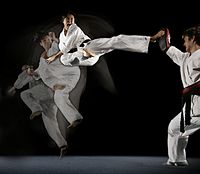
In that location are also many kicks that involve jumping earlier their execution. These include the jumping front end boot ( ee dan ap chagi ), jumping side kick (이단 옆 차기 idan yeop chagi ), flight side kick, jumping axe kicking, jumping roundhouse ( ee dan dollyeo chagi ), jumping spinning hook kick, jumping spinning roundhouse kick, jumping back kicking, and bound spinning side kick. Normally, jumping kicks involve pulling upwards the back leg to help gain elevation during the bound and so performing the kick itself with the front leg.
- Advanced kicks: There are a diversity of kicks that tin be used in combination or stem out from a simple kick to create more difficult ones. Some of these include 540 Kicking (One spins 1½ times in mid-air and does a kick, unremarkably a dorsum spinning claw boot), a 720 Kick (the practitioner spins 2 times in mid-air and performs a kick, usually a dorsum spinning claw kick), and Triple Aero Kicks (Practitioner performs round business firm kicking, back spinning hook kick, and another round business firm kick in mid-air).
- Fast Kicks: Likewise, many kicks can be employed using a fast boot style. The practitioner shuffles the back leg forward to the front leg, and the front leg comes up and kicks closer to the enemy than the practitioner had been before execution. This tin be used with side kicking, roundhouse kick, front kick, hook kick, and axe kicking.
- Monkey Kick: This is an awkward, ineffectual kick that is just barely impactful plenty to cause hogu that are rigged for electronic scoring to annals a signal, especially in WT (formerly WTF) - style sparring. Information technology is often cited as an example of how the practice electronic scoring harms sport Taekwondo. Electronic hogu accept embedded sensors that detect the vibration from a blow. In principle, the thought is that a legitimate taekwondo kick (such every bit a roundhouse boot) volition impact the hogu and cause the sensors to vibrate -- thus scoring a point. Because there is no guarantee that the legitimate kicking will impact directly on the sensor, the sensors demand to be calibrated to detect even "light" impacts. This kick takes advantage of this light calibration past allowing the competitor to score a indicate with a simple, awkward tap of the foot on the hogu, every bit long as the affect occurs well-nigh a sensor. In the instance of a Monkey Boot specifically, this light impact is accomplished past tapping the bottom of the foot against the opponent's sensor while standing very close to the opponent.
- Afterwards many complaints from dissimilar Fellow member National Associations, the WT Technical Commission decided to sanction the athletes who used the technique in backlog. The Commission likewise called all coaches from the participating countries for a meeting so the coaches could express their opinions about the technique and state of affairs[ane]
- Lower Kick: This kick can disarm the opponent if done with a lot of strength but if the opponent is on the baby-sit the kick might non piece of work.
Blocks [edit]
Taekwondo blocks known equally Makgi are used to stop and deflect an incoming assail. They engage various parts of the arm with the hand and are held in different positions such as knife-hand, airtight fist etc. Each block is suitable for a particular kind of assault and may be combined with some other punch or kick to brand a counter-assault.
- Single Forearm Block - Wae Sunday Palmok is used to deflect an set on (usually a kicking) made at the torso. Starting up near the opposite shoulder, and the leading hand is projected downward and across the body to deflect the kicking with the forearm.
- Low Block - Najundi Makgi is used to defend against low attacks to the torso or legs. This is one of the most basic Taekwondo blocks and one of the first things a beginner volition learn. The lead forearm is aptitude and raised to shoulder pinnacle, snapping the arm downward directly with the palm facing the ground, which blocks any incoming low kicks.
- Rising Block - Chookya Makgi is some other basic Taekwondo block, used to defend confronting overhead attacks to the head and shoulders. The arm is bent and raised above the caput, and the underside of the forearm absorbs the bear on of the accident, which may be painful only is better than it connecting with your head or delicate clavicle. This cake is used to defend against Hammerfists, Axe Kicks and overhead strikes with edgeless instruments.
- Palm Block - Sonbadak Naeryo Makgi is a standard block used to deflect incoming kicks and punches. The open up manus is raised up to shoulder height and thrust direct down to meet the attackers limb. The heel of the hand makes contact with the assaulter'south forearm in case of a punch, or shin in case of a boot. Although simple, information technology requires a lot of partner grooming to get the timing of this Taekwondo block right.
- Knife Hand Block - The hand is kept in a knife hand position to block attacks to the torso. As the front end arms sweeps down in an arc from the inside to the outside of the body, the dorsum hand is simultaneously pulled dorsum to the back hip and ready for a counter punch.
- Double Forearm Cake - This is a more advanced Taekwondo block, designed to be used against a strong attack to the center of the body. Standing sideways, the lead forearm blocks the attack with the fist closed. The second arm provides further support, linking into the crook of the arm and so both forearms are at a 90 degree angle to the body.
- Double Knife Mitt Cake - With the hands held open in the knife hand position, a powerful kick aimed at the solar plexus tin be successfully blocked. Both hands come across the trunk, intersecting at the forearms and providing a house defense force.
- Nine Cake - This is a blackness chugalug leveled block and the first time information technology is usually used is around the black belt grade. The person blocks their breast with one mitt and stomach region with the other. The shape of the block forms a number nine when executed correctly. Both artillery are bent at a 45 degree angle as well and it leaves little space open in the mid region of the defenders body. Your manus when this move is executed correctly should also exist above your groin on the lesser and next to you opposite shoulder with the summit paw.
- Upper Block - Also known as the Ulgul Makgi. The one using the block commencement keeps their fist sideways at the breadbasket or torso. They so rise the fist up to their head, deflecting the attack. Whatever attack made at the upper role of the body is blocked if timed correctly using this cake.
Patterns, Poomsae, Hyung, Tul [edit]
Taekwondo patterns, too known as poomsae, teul, or hyeong constitute an important part of Taekwondo competitions.[ii] A pattern is a serial of movements linked together in a prescribed sequence. Both bones and advanced taekwondo techniques can be independent within a unmarried patterns and the college the level of the competitor, the greater the difficulty of the techniques and the complexity of the pattern. Competitors must perform their highest pattern in front end of a panel of judges.
At that place are 3 types of Taekwondo pattern contest:
- Team Taekwondo patterns - Performed simultaneously past several competitors from a club organised into a unmarried team. Club teams compete by performing 2 patterns each, one after the other. Once one team have finished both their patterns tin the competing team and then perform theirs. Again, the judges choose the best pattern to go through to the next round.
In taekwondo tournaments, pattern competitions are more often than not graded on:
- Realism. Taekwondo patterns are the learning ground for real gainsay. As such, every technique must display the requisite speed, power and firmness to exist realistically used as an attack or defines motility.
- Spirit. A competitor'southward 'presence' on the mat must exist as credible equally his technique. Self belief, confidence in abilities, and intention to perform to a personal best are tangible virtues considered indispensable in Taekwondo practitioners.
- Decorum. Proper manners must be displayed when interacting with the judges directly before and after the pattern. Respect must also be extended to rival competitors, clubs and other officials.
- Form. General qualities that judges await for in whatsoever Taekwondo practitioner include proper breathing technique and body control. The diaphragm must be engaged in deep breathing, shallow breathing concentrated in the upper abdomen results in raised shoulders and stressed muscles. The muscles of the torso should be lightly relaxed in order to perform the pattern with fluidity, speed and grace. Muscles should simply be tensed at the moment of imaginary impact in order to commute maximum ability to whatsoever individual Taekwondo technique
Cocky defense [edit]
Taekwondo self-defense is known as kinuo and information technology forms one of the twenty primary principles of the fine art. The self-defense applications would exist difficult to score in sparring as they are designed primarily to crusade injury or quickly incapacitate an adversary.
In competition, cocky-defence force techniques take the format of a demonstration event, much like ponomoom. I person is normally designated the part of the Taekwondo practitioner, while several teammates have the role of common street aggressors who attack from diverse angles with punches, kicks and grabs common to street brawlers. Weapons may too be used, as Taekwondo has specific techniques for dealing with armed adversaries.
Taekwondo cocky-defense contest provides an opportunity for students to display their understanding of Taekwondo self-defense applications and the ability to put together their own team choreography. Cocky-defense force routines are often performed as displays for the public, in which case in that location are no judges nowadays. Many Taekwondo clubs include cocky-defence in their daily routine in both WTF and ITF.
There are ii principal concepts in Taekwondo self-defence force. For real life combat situations, an experienced Taekwondo practitioner is versed in the following:
- Linear (or difficult) techniques
- Circular (or soft) techniques
Linear Techniques
These include more often than not punching, kicking, headbutts and other striking maneuvers. Forcefulness is countered with force and all limbs are involved in stopping an adversary. Taekwondo kicks have a wide attain that keeps the adversary at a altitude. With proper execution opponents may exist incapacitated with a single blow, which lessens the number of attacks in encounters with multiple people.
Circular techniques
These emphasize redirection and manipulation rather than force. The adversary tin can exist manipulated into a position whereby a lock, stranglehold and/or finishing move can exist applied. Grappling techniques are used both equally a means of securing an antagonist and escaping from an adversary'due south grip. Soft self-defense force techniques like the stranglehold or articulation lock can be used to subdue the attacker, avoiding dealing permanent injury.
Taekwondo self-defence force techniques demonstrated in competition may include:
- Pressure point applications.[3] In Taekwondo philosophy, the trunk has many sensitive areas that are susceptible to precise attack. These are known as pressure points or ji ap sul . At that place are three types of pressure signal that can induce 1 or a combination of the following: pain, paralysis, or decease. These can be targeted with gripping and/or hitting in order to immobilize or cause substantial pain to submit the opponent.
- Throws. Known as too sul , Taekwondo practitioners can divert the opponent's force to their ain advantage and throw him to the ground. Once on the footing the practitioner has greater control over his adversary and can follow up with subsequent controlling or finishing techniques.
- Joint Locks. Otherwise known as kwan jyel sul in Taekwondo, these can be useful against armed attackers. Typically the attacking limb is grabbed and and then manipulated to cause immense pain in the adversary. Joint locks tin exist practical on any joint in the torso and are particularly useful for controlling an opponent who has been thrown to the ground.
- Termination techniques. These are a range of strikes applied to an opponent downed by a previous throw or strike. Powerful downward traveling kicks and hand strikes are used to brand certain the opponent stays downwards.
- Choking techniques. In chil sik sul , the idea of applying a stranglehold is to deprive the attacker's brain of either oxygenated blood through the carotid artery and/or oxygen for the lungs through the trachea. The Taekwondo practitioner uses leverage from his arm and sometimes involves the attackers clothing in applying pressure to the sensitive cervix area. Asphyxiate holds are specially unsafe and only taught to higher level Taekwondo students, as over exertion tin can crush the trachea or cause sudden expiry.
- Freeing techniques. Paegi are taught to Taekwondo students and so that they tin can quickly costless themselves and neutralise the danger of being grabbed by an aggressor. Competition demonstrations often involve one student grabbing another from backside. The science of Taekwondo is as concerned with defense every bit attack so proper freeing techniques must be learnt.
Like other Taekwondo contest events, self-defense is marked past a panel of judges. When scoring they are looking at the following factors:
- Aliveness. How realistic is the Taekwondo students demonstration? Does he movement with the requisite urgency and practise his techniques have the emotional content to make the judges believe in their power?
- Technique. Are the Taekwondo techniques being demonstrated precisely? Are the kicks clean, fast and strong? Are joint locks and throws being performed accurately? Does the educatee take control over his adversaries or are they making it like shooting fish in a barrel for him?
- Multifariousness. What is the range of the Taekwondo practitioners knowledge? Is he showing his understanding of liner and direct counter-attacks? Has he performed a practical finishing technique after each throw or lock?
- Difficulty. More difficult Taekwondo techniques score college than simple ones if performed correctly. However, a poorly executed technique will ever score lower than a elementary, effective technique performed well; students should not exist demonstrating techniques that they have not mastered.
References [edit]
- ^ "The "Monkey Kick", anti Taekwondo". 21 May 2015.
- ^ Taekwondo Forms
- ^ link not working
Further reading [edit]
- Mod Taekwondo:The Official Grooming Manual, Presently Man Lee and Gaetane Ricke; Sterling Publishing Visitor, New York, NY; copyright 1999
- Traditional Taekwondo:Core Techniques, History, and Philosophy, Master Doug Cook; YMAA Publication Eye, Boston, Massachusetts; copyright 2006
- Forces of Tae Kwon Practice, Edward B Sell and Brenda J Sell; U.Southward. Chung Do Kwan Association, Lakeland, Florida; copyright 2004
Source: https://en.wikipedia.org/wiki/List_of_Taekwondo_techniques

Post a Comment for "How to Come Up With Martial Arts Moves Names"